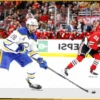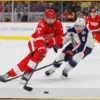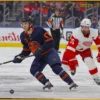
For decades, from the 1970s to the early 2000s, hockey fights were a common sight, deeply ingrained in the sport’s identity. However, recent trends suggest a significant shift.
While the era of the dedicated “enforcer” seems to be over, it’s worth considering whether fighting is truly disappearing from the NHL or simply transforming into a strategic tool.
The Historical Decline: From Enforcers and Line Brawls to Calculated Fights
Following the 1967 NHL expansion, fighting saw a rise, notably fueled by the intimidating “Broad Street Bullies” of the Philadelphia Flyers in the mid-1970s. The 1980s marked the peak of fighting in the NHL, with games averaging over one fight each. The 1987-88 season saw the highest point, with an average of 1.10 fights per game.
In earlier times, teams relied on “enforcers” – players unafraid of physical play, tasked with protecting star players. Figures like Bob Probert, Scott Stevens, Dale Hunter, Rob Ray, and Tie Domi are remembered for their ability to energize crowds and galvanize their teams through fighting.
The introduction of the instigator rule in 1992, penalizing players who initiated altercations, was a significant deterrent. After a brief resurgence in fighting during the 2003-04 season, likely due to veteran heavyweights’ farewell tours, the traditional enforcer role diminished following the 2004-05 NHL lockout.
The implementation of a strict salary cap in 2005 made it difficult for teams to justify dedicating a roster spot solely to a fighter. Concurrently, rule changes that removed the red line and limited obstruction accelerated the game’s pace and emphasized skill.
By the 2010s, with increasing awareness of concussions and CTE, pure enforcers became more of a liability than an asset. Consequently, fighting rates declined sharply, falling below 0.20 fights per game by the 2020s.
Why Some Teams Still Drop the Gloves
Despite the overall downward trend, fighting has not disappeared entirely. Instead, it has become more concentrated and strategic. Data reveals that certain franchises consistently rank high in fighting statistics.
For the 2025-26 season, the Tampa Bay Lightning led the league with an average of 0.54 fights per game. The Boston Bruins followed at 0.40, with the Anaheim Ducks close behind at 0.32, all significantly above the NHL average of 0.23 fights per game.
Individually, Mark Kastelic of the Boston Bruins and Curtis Douglas of the Vancouver Canucks led the league with 10 fights each. Even goalie fights saw a minor resurgence, with three recorded during the season.
These discrepancies are often attributed to roster composition, divisional rivalries, and specific team strategies. Teams in more physical divisions, facing opponents who employ intimidation, are more prone to engaging in fights.
Fights today primarily occur in two situations: (1) Immediate Retaliation: Responding instantly to a questionable or dangerous hit on a star player. (2) Momentum Shift: An attempt to energize a struggling team or rally the home crowd.
The Generational Shift: How Younger Players View the Game
The evolution of physicality in hockey is largely driven by a generational shift. Today’s NHL rookies have been developed in systems that prioritize elite skating, puck handling, and agility above all else. Junior and college leagues often heavily penalize fighting, leading younger players to view it as an uncommon part of their game upon entering the NHL.
When modern players engage physically, it’s typically to battle for pucks along the boards or fight for positioning in front of the net, using their bodies to gain an advantage and control the ice, rather than engaging in fisticuffs.
Fan Opinions: A Divided Hockey Culture
Fighting remains a deeply divisive topic among hockey fans. One group prioritizes player safety and concerns about head injuries, while the other values the traditional aspects of the game, including fighting.
A poll conducted in April 2026 revealed a stark divide: 49% favored a ban on fighting, while 47% wished to keep it in the sport.
Advocates for eliminating fighting argue that hockey shines brightest when showcasing elite skill, and player safety should always take precedence over older notions of entertainment. Conversely, traditionalists maintain that fighting is an inherent part of the game.
They also believe that the potential for retaliation deters dangerous play and helps protect star players.
Evolution, Not Extinction
Is fighting disappearing from hockey? No. However, it has evolved and will continue to change in the future.
The NHL has transitioned from an era of frequent, casual fights to one of situational confrontations. While the overall number of fighting majors is likely to remain at historic lows, the data indicates that physicality continues to be a strategic element for several NHL clubs.