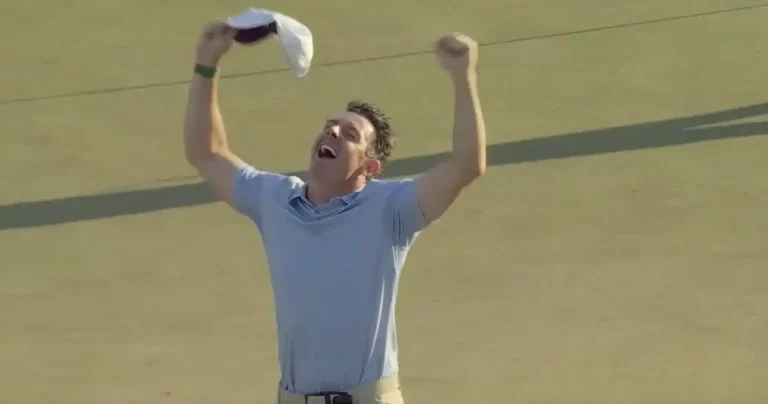
Despite trailing by three shots during the final round of the Masters, Rory McIlroy demonstrated remarkable resilience. The Northern Irish golfer rallied with four birdies in a seven-hole span as his competitors faltered on the back nine at Augusta National Golf Club.
This surge allowed McIlroy to reclaim the lead and secure his second consecutive Masters championship, joining an elite group of golfers – Jack Nicklaus, Tiger Woods, and Nick Faldo – who have achieved back-to-back victories at Augusta.
“I can’t believe it took me 17 years to win my first green jacket, and now I have two in a row,” McIlroy expressed, reflecting on his final-round 71 (1-under par) that brought his total to 12-under. His one-shot victory over two-time champion Scottie Scheffler marked a significant achievement. “I feel like all the perseverance I’ve put into this tournament over the years is finally paying off. It was a challenging weekend.”
Scottie Scheffler, who had a bogey-free weekend with rounds of 65 and 68 after an even-par start, finished in second place. Four other players, including third-round co-leader Cameron Young, who closed with a 73, tied for third at 10-under.
McIlroy’s Strong Start and Mid-Round Fightback
McIlroy began the tournament strongly with opening rounds of 67 and 65, establishing a six-shot lead. However, a Saturday round of 73, coupled with Cameron Young’s 65, saw them tied at 11-under heading into the final day.
“I did most of the crucial work on Thursday and Friday, but I’m incredibly pleased that I managed to hang on and get the job done,” said McIlroy, who earned $4.5 million for his sixth major championship win.
After tying Young with a birdie on the third hole, McIlroy encountered a setback with a double-bogey on the par-3 fourth, resulting from a three-putt from under five feet. A subsequent bogey on the par-3 sixth dropped him to 9-under.
Meanwhile, Justin Rose made a strong move, birdying four of his last five holes on the front nine to reach 12-under. However, his challenge faded with bogeys on holes 11 and 12. By this time, McIlroy had regained momentum with birdies on holes 7 and 8, bringing him to 11-under.
“If I hadn’t birdied the seventh and eighth holes, I might have felt the need to push harder,” McIlroy commented. “But seeing Justin bogey 11 and 12… I never felt out of contention. It’s inevitable that players will make mistakes on this course.”
On the notoriously difficult par-3 12th, a hole that has often decided the Masters, McIlroy delivered an exceptional tee shot, landing his 9-iron just seven feet from the pin, and sinking the subsequent birdie putt.
He continued his impressive play with a two-putt birdie on the par-5 13th, reaching the green in two shots with a 6-iron after a powerful tee shot. This put him at 13-under, and he skillfully navigated the remaining holes to secure the victory.
“After the bogey on the sixth, I told myself, ‘Okay, if I can get to 14-under, I think I have a good chance to win this tournament.’ I didn’t quite reach 14, but 13 was a strong enough position standing on the 18th tee,” McIlroy reflected.
McIlroy’s Remarkable Putt on the 16th
Arguably more impressive than his tee shot on the 12th was McIlroy’s putt on the par-3 16th. From off the back of the green, his putt resembled Tiger Woods’ iconic chip-in on the same hole during his 2005 Masters win. McIlroy’s putt curved away from the hole, then rolled down the slope to within inches of the cup, setting up an easy tap-in for par.
His only significant stumble in the closing stretch occurred on the 18th. With a two-shot cushion, his drive found the trees, leading to a punch shot into a greenside bunker, a splash-out onto the green, and ultimately a two-putt bogey. However, this was enough to secure the win.
“It’s certainly a comfort to have that two-shot lead as opposed to the one I had last year,” McIlroy added.