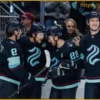
The Seattle Kraken are undertaking management shifts this offseason, with Ron Francis stepping down as President of Hockey Operations. Francis, the team’s inaugural general manager, had transitioned to the presidential role earlier in the season when Jason Botterill was promoted to general manager.
Despite Francis’s departure, the Kraken organization is focused on identifying the root causes of their struggles since their inception in the 2021-22 season. The team is poised to miss the playoffs for the third consecutive year and for four out of their first five seasons. It’s even argued that the Kraken’s 2023 playoff appearance was a stroke of luck.
Since that playoff berth, a series of poor decisions by the management team have been evident. A notable misstep was letting go of Morgan Geekie for nothing, as they failed to qualify the then 24-year-old after a 19-assist, nine-goal season in 69 games. Geekie has since scored 89 goals in the last three seasons for the Bruins, with 37 this current season – a significant offensive contribution any team would value.
In light of these recurring issues over the past three seasons, CEO Tod Leiweke announced that the organization will conduct a comprehensive, independent audit of its hockey operations, with the current general manager, Jason Botterill, spearheading the initiative.
“We are going to conduct a full independent audit of hockey operations. Jason (Botterill) will lead it, but we’re going to bring fresh eyes and make sure that there’s no stone unturned,” Leiweke stated.
The question arises: what does such an audit truly entail? How can flaws within a hockey operations department be quantified and addressed? The investigation may need to trace back to the team’s very beginnings, perhaps even to the hiring of Ron Francis. His tenure with the Carolina Hurricanes saw no playoff appearances in eight seasons, first as director of hockey operations and then general manager (2014-2018), before becoming president of hockey operations. While he oversaw drafts that produced strong forwards like Sebastian Aho, Martin Necas, and Morgan Geekie, as well as defensemen Jaccob Slavin and Brett Pesce, this approach didn’t translate to postseason success.
Francis attempted to replicate a similar strategy with Seattle, but this time with the advantage of drafting NHL-ready players rather than developing them. This included acquiring players like Taylor Hall, Vladimir Tarasenko, Nikita Zadorov, and Brandon Montour (who joined as a free agent in 2024), among others.
The team’s construction, prioritizing complementary pieces over game-changing talents, has been criticized. While Seattle aimed to emulate the Vegas Golden Knights’ expansion success in 2017, other general managers became more cautious after Vegas’s remarkable run to the Stanley Cup Final in their inaugural season. Nevertheless, Seattle had access to a talented pool of players during its expansion draft.
The strategy of building a team based on analytics and data has proven ineffective. Furthermore, relying solely on the draft hasn’t yielded the desired results. The team was built with a strong defensive core but lacked a pure offensive sniper capable of changing the game. This is precisely the type of player the Kraken have reportedly pursued this season. While Vince Dunn and Adam Larsson are solid defensemen, the signing of Chandler Stephenson is increasingly viewed as a poor decision.
The ultimate goal for the Seattle Kraken is to become a consistent playoff contender capable of challenging for the Stanley Cup. While replicating the immediate success of the Vegas Golden Knights might be unrealistic, there’s a clear indication that the Kraken’s operational framework is fundamentally flawed. Seattle is a vibrant hockey market, yet the Kraken struggle to compete with the city’s other professional sports teams, the Seattle Mariners (who reached the ALCS) and the Seattle Seahawks (who won the Super Bowl).
Leiweke has communicated that a new, long-term strategy is necessary and that fans will be kept informed of progress at every stage.
“We’re going to develop a multi-faceted, multi-year plan to strengthen our roster. We talk a lot about recruiting free agents. We’ve got to do more to make this a hockey city to keep players, to attract other players,” Leiweke explained. “We’re going to set mile markers. Fans are going to know where we are.”
The Kraken have previously pursued high-profile players like Artemi Panarin, Robert Thomas, and Jordan Kyrou. However, it was widely understood that Panarin preferred playing in a major market, despite reports of a substantial contract offer. The appeal of a no-state-income tax diminishes significantly if the team isn’t winning, a lesson previously learned by teams like the Florida Panthers and Nashville Predators before their respective turnarounds.
Winning is paramount for players. Organizations like the Tampa Bay Lightning, Dallas Stars, Utah Mammoth, Golden Knights, and Panthers attract talent because of their success. Financial incentives often become secondary when a team is not competitive, and the Kraken have not achieved this competitive edge.
Francis’s departure is seen as a recognition of his role in the ongoing issues. A critical oversight was failing to move their remaining three pending unrestricted free agents (Jamie Oleksiak, Eeli Tolvanen, and Jaden Schwartz) after trading Mason Marchment and re-signing Jordan Eberle. Not acquiring assets for these players represents another missed opportunity.
While the acquisition of Bobby McMann is significant, he is also a pending UFA at the end of the season. At the trade deadline, the Kraken held the second wild-card spot and were still in contention in the weak Pacific Division. However, if they had no intention of extending their UFAs, they should have secured future assets in return. Simply making the playoffs only to be quickly eliminated in the first round would not have advanced the team’s long-term prospects, representing another lost opportunity.
As Leiweke has repeatedly emphasized, “We have a hell of a lot of work to do. There is a burning fire to get this fixed.” The situation in Seattle is undeniably a mess.
Although the Kraken are retaining Botterill to oversee both hockey operations and general management during what will be either a rebuild or a retool, his future, and that of head coach Lane Lambert, remains uncertain. Leiweke was non-committal regarding Lambert’s status, indicating that the team needs to determine the right path forward.
Losing organizations often find themselves trapped in a cycle of underperformance due to constant coaching changes, which hinders player development and team chemistry. Breaking this cycle by hiring the right people and adhering to a long-term plan is the crucial first step. Subsequently, the team needs to find players capable of executing that vision.
If further struggles lie ahead for the Seattle Kraken, it may be a reflection of the typical challenges faced by expansion franchises. However, a more effective initial strategy could have potentially averted the need for a complete overhaul.